
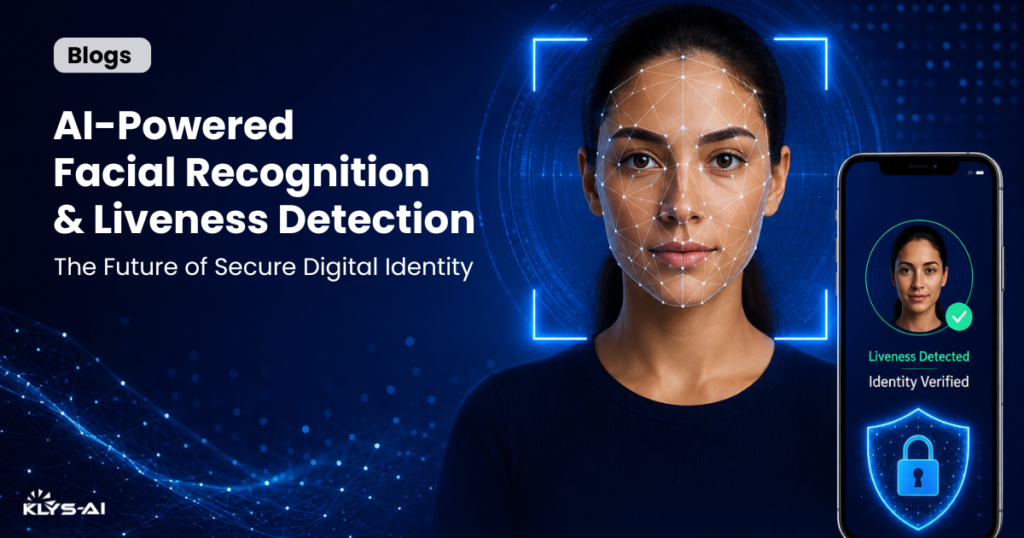
Every second, thousands of digital identities are created, verified, and authenticated across banking, healthcare, e-commerce, telecommunications, and government platforms. While digital transformation has made customer onboarding faster, it has also created new opportunities for cybercriminals using stolen identities, deepfake technology, printed photos, replay attacks, and synthetic identities.
This is where Facial Recognition and Liveness Detection are reshaping digital identity verification. Together, they enable organizations to verify not only who a person is, but also whether they are physically present during the verification process, significantly reducing identity fraud while improving user experience.
This article explores how these technologies work, why they matter, where they are being used, and what businesses should consider before implementing an AI-powered identity verification solution.
What Is Facial Recognition?
Facial Recognition is an AI-driven biometric technology that identifies or verifies an individual by analyzing unique facial characteristics.
Instead of relying on passwords or security questions, the system maps facial landmarks such as:
- Eye distance
- Nose structure
- Jawline geometry
- Facial contours
- Skin texture
- Relative positioning of facial features
These characteristics are converted into a mathematical biometric template rather than storing a traditional photograph. During verification, the live face is compared against a trusted reference image, such as a passport, driver’s license, or government-issued ID.
Why Facial Recognition Alone Is No Longer Enough
Although AI facial recognition has significantly improved digital identity verification, attackers have become increasingly sophisticated.
Modern fraud attempts include:
- Printed photographs
- High-resolution mobile displays
- Video replay attacks
- Deepfake videos
- AI-generated synthetic identities
- Silicone masks and 3D facial replicas
A facial recognition engine may accurately match a face without realizing it is looking at a photograph instead of a real person.
This limitation introduced the need for an additional security layer: Liveness Detection.
What Is Liveness Detection?
Liveness Detection is an AI security mechanism that determines whether the individual in front of the camera is physically present rather than an imitation.
Rather than simply recognizing facial features, the system analyzes subtle human characteristics that are difficult to replicate.
These may include:
- Natural facial movements
- Eye reflections
- Skin texture variations
- Micro-expressions
- Depth perception
- Light interaction across the face
- Three-dimensional facial geometry
The objective is simple:
Verify that the face belongs to a real, live person—not a spoof.
This dramatically strengthens AI identity verification systems against modern fraud techniques.
Active vs Passive Liveness Detection
There are two primary approaches to liveness detection.
|
Active Liveness Detection |
Passive Liveness Detection |
|
Requires user interaction |
No user action required |
|
Blink, smile, or turn head |
Works automatically |
|
Longer verification process |
Faster user experience |
|
More friction during onboarding |
Seamless verification |
|
Suitable for high-risk scenarios |
Ideal for large-scale customer onboarding |
Many modern organizations prefer passive liveness detection because it delivers stronger security without interrupting the customer journey.
Why Businesses Are Adopting AI Identity Verification
Organizations today are balancing two priorities:
- Prevent fraud
- Deliver frictionless customer experiences
Facial Recognition and Liveness Detection enable both.
Key Benefits
Stronger Fraud Prevention
Blocks common attacks including:
- Photo spoofing
- Replay attacks
- Deepfake impersonation
- Synthetic identity fraud
Faster Customer Onboarding
Customers can complete identity verification within seconds without visiting a physical branch.
Improved User Experience
Modern AI minimizes unnecessary verification steps, reducing abandonment during digital onboarding.
Regulatory Compliance
Many regulated industries require robust identity verification as part of Know Your Customer (KYC) and Anti-Money Laundering (AML) programs.
AI-powered verification helps organizations strengthen compliance while improving operational efficiency.
Reduced Operational Costs
Automated verification decreases dependence on manual review teams and shortens processing times.
Common Challenges Businesses Should Consider
While AI-powered identity verification offers significant advantages, successful implementation requires careful planning.
Organizations should evaluate:
- Algorithm accuracy across diverse demographics
- Data privacy and consent management
- Compliance with regional regulations
- Secure biometric data storage
- Low-light and poor-camera performance
- Continuous AI model improvements
Choosing a solution with robust security practices and transparent governance is essential for building long-term customer trust.
The Future of Facial Recognition and Liveness Detection
Identity verification is rapidly evolving beyond static facial matching.
Emerging innovations include:
- Behavioral biometrics
- Continuous authentication
- Deepfake-resistant AI models
- Multimodal biometric verification
- Edge AI for on-device processing
- Privacy-preserving biometric encryption
- Adaptive risk-based authentication
Future identity systems will increasingly combine multiple biometric signals to deliver both stronger security and greater user convenience.
Best Practices for Implementing AI Identity Verification
Before deploying a facial verification solution, organizations should ensure it:
- Uses advanced AI facial recognition algorithms
- Supports passive liveness detection
- Detects presentation attacks and deepfakes
- Integrates easily with existing onboarding workflows
- Meets applicable privacy and compliance requirements
- Delivers high verification accuracy with low false acceptance and rejection rates
- Provides a seamless user experience across mobile and desktop devices
Selecting the right technology partner is as important as choosing the technology itself.
Ready to Strengthen Your Digital Identity Verification?
With digital-first services becoming the norm, organizations must find secure ways to verify identities remotely without compromising user experience or security.
Facial Recognition and Liveness Detection provide a powerful combination for secure, scalable, and user-friendly AI identity verification. By confirming both a person’s identity and their physical presence, these technologies help reduce fraud, streamline onboarding, and support compliance without adding unnecessary friction.
FAQ
1. What is the difference between facial recognition and liveness detection?
Facial recognition verifies whether a person’s face matches a trusted identity, while liveness detection confirms that the individual is physically present during the verification process. Together, they provide a more secure AI identity verification workflow.
2. Which industries benefit the most from AI-powered identity verification?
Industries such as banking, fintech, healthcare, insurance, telecommunications, government, e-commerce, travel, and enterprise security commonly use AI identity verification to secure digital onboarding and protect sensitive transactions.
3. Can facial recognition and liveness detection improve customer onboarding?
Yes. AI-powered verification automates identity checks, reducing manual reviews and enabling customers to complete onboarding securely within minutes while improving the overall user experience.
4. How does AI identity verification help reduce fraud?
AI identity verification analyzes facial biometrics, detects spoofing attempts, verifies physical presence, and identifies suspicious patterns that traditional verification methods may not detect.
5. Why should businesses use facial recognition with liveness detection instead of facial recognition alone?
Facial recognition alone may not detect spoofing attempts such as printed photos, replay videos, or deepfakes. Adding liveness detection helps verify that the user is genuine and physically present, strengthening identity verification and reducing fraud risks.